In the fast-moving world of texting, chat, and social media, shorthand acronyms often spread like wildfire. One you may have seen is IMK. But what does IMK mean in text?
People search for it because it’s not always obvious — is it “In My Knowledge,” “I’m Just Kidding,” or something else entirely? In this article we’ll dive into the meaning, usage, origins, and nuances of IMK across platforms.
Whether you saw it in DMs, comments, or group chat, by the end you’ll be confident interpreting and even replying to it — all while keeping your tone natural and clear.
Meaning & Definition

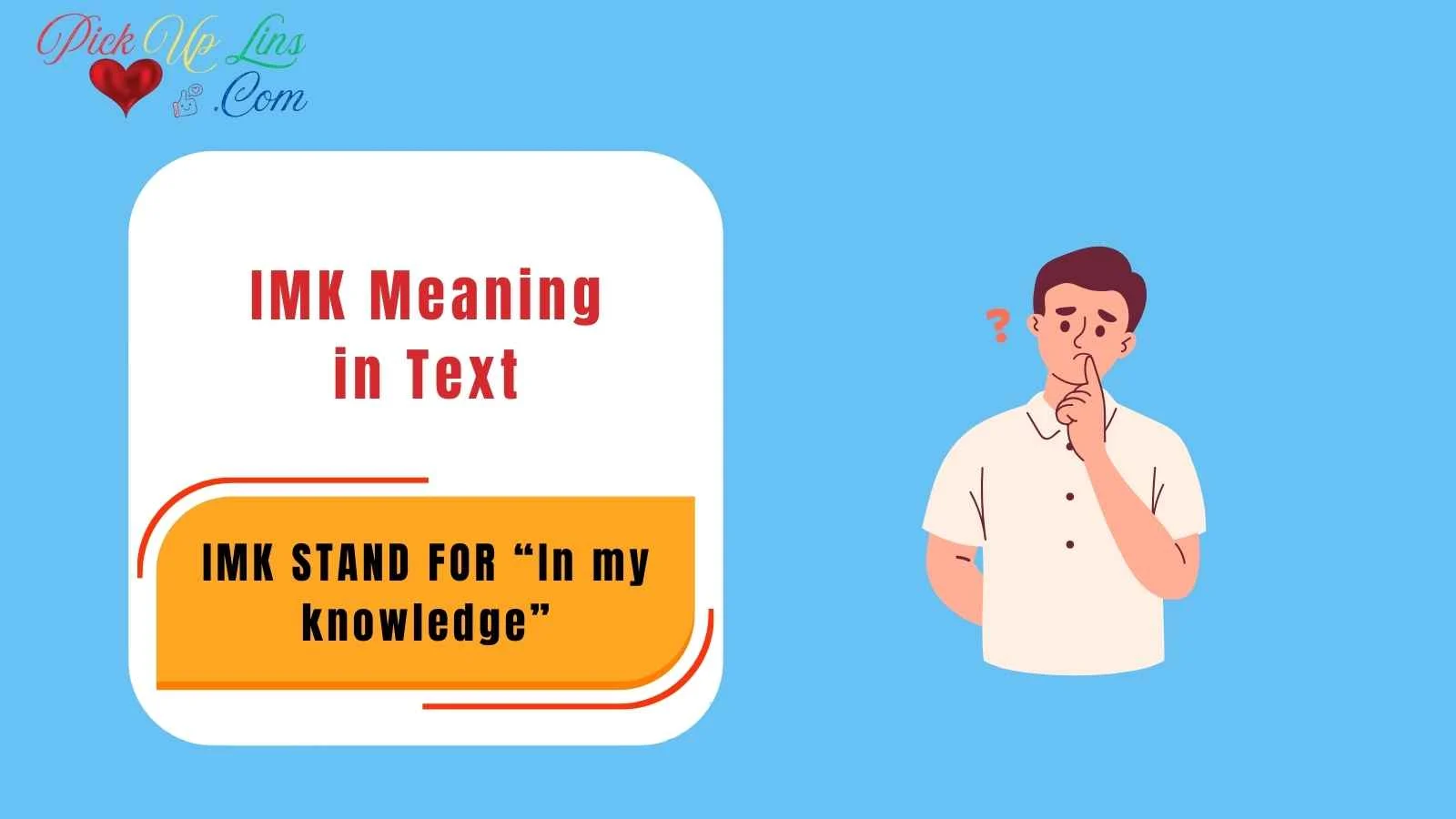
At its core, IMK is an acronym used in informal written communication (texting, chat, social media). Its primary meaning is:
- “In my knowledge” — used to indicate that what follows is according to one’s understanding or what one believes to be true, though not guaranteed.
However, like many acronyms, IMK can carry secondary or alternate meanings depending on context and tone. Some of these include:
- “I’m just kidding” — when the speaker wants to flag a statement as a joke or playful.
- “I must know” — used when someone is pressing for information (less common).
- Occasionally, people may misinterpret or repurpose IMK in creative or sarcastic ways, so context is key.
In typical use, IMK softens a statement — it’s a qualifier, suggesting, “take this with caution; I’m not claiming certainty.”
Background & Origin
Because texting acronyms evolve organically, tracing a single origin for IMK is difficult. It likely emerged as part of internet and SMS shorthand culture, where users looked to compress common phrases into shorter forms.
The phrase “in my knowledge” itself is a variation on more established qualifiers like “to the best of my knowledge” or “as far as I know.”
Over time, as people typed quickly and informally, IMK probably crystallized as a briefer way to convey that sentiment.
There is also some confusion between IMK and LMK (“let me know”), especially since uppercase “I” and lowercase “l” can look similar in many fonts. Some sources claim that IMK is in fact a mis-typing or mis-reading of LMK. (But IMK has its own distinct usage now too.)
Because slang and acronyms tend to adapt across communities (forums, chat apps, social media), IMK doesn’t have a single documented inventor — it’s a grassroots creation of digital language users.
Usage in Different Contexts
Casual Chat & Texting
In everyday chats, IMK is commonly appended to statements to reflect uncertainty:
- “IMK, the meeting is at 3 pm.”
- “It’s closed on Sundays, IMK.”
It’s friendly and non-assertive, often used among friends, peers, or informal groups.
Social Media Comments & Replies
On platforms like Instagram, TikTok, or Twitter, users may drop IMK in comments to suggest their knowledge is what they believe but not necessarily authoritative. For example:
“IMK, that cafe just reopened after renovation.”
Community Forums & Q&A
In forums or knowledge communities, someone giving advice or information might write IMK to hedge their answer:
“IMK, that function was deprecated in the new version of the library.”
Professional or Semi-Formal Use
In more formal settings (workchat, Slack, email), IMK is much less common because it sounds casual. Instead, people often write the full phrase: “To the best of my knowledge” or “As far as I know.”
Meanings Across Platforms
Here’s how IMK tends to show up on different apps:
| Platform | Common Meaning of IMK | Notes |
|---|---|---|
| WhatsApp / Texting | “In my knowledge” (or “I’m just kidding” in playful chats) | Used in direct messages and group chats |
| “In my knowledge” | Often in comments or captions to soften claims | |
| TikTok | “In my knowledge” or joke variant | Appears in captions, comments, or replies |
| Snapchat | Less frequent usage | Because texts are more ephemeral, usage is lower |
| Forums / Reddit | “In my knowledge” | Seen in explanatory or advisory posts |
Because each platform has its own tone and audience, IMK might lean more heavily toward certainty-hedging (its “knowledge” meaning) or joking (its “kidding” meaning).
Other Fields — Technical, Scientific & Institutional Meanings
Outside everyday texting slang, IMK may appear as an acronym or code in technical, institutional, or specialized contexts. Some examples include:
- Simikot Airport (Nepal) — IATA code IMK for an airport in Nepal.
- Innenministerkonferenz (Germany) — a conference of state interior ministers, abbreviated IMK.
- Institute for Macroeconomics and Conjunctural Research — an economic institute abbreviated IMK in Germany (Institut für Makroökonomie und Konjunkturforschung).
- Intermolecular forces (Chemistry) — sometimes abbreviated as IMK in certain languages (though more commonly “IMF” or “vdW” etc.).
- Islamic Movement in Kurdistan — a political group sometimes shortened as IMK.
In these fields, IMK is not related to texting slang, so you’d interpret it from the subject area, not from casual usage.
Common Misconceptions & Mistakes
-
Confusing IMK with LMK
Many assume IMK is a typo for LMK (“let me know”) because uppercase “I” and lowercase “l” look similar in many fonts. But IMK and LMK are distinct in meaning. -
Assuming “IMK” always means “I’m just kidding”
While that interpretation exists, it’s secondary and less common. Taking “IMK” to always mean joking may lead to misreading someone’s tone. -
Overusing IMK in formal writing
In professional or academic writing, such slang may come off as unprofessional. It’s better to use full phrases like “to the best of my knowledge.” -
Ignoring context
Because the meaning of IMK can shift depending on tone, preceding text, or platform, blindly translating every IMK as “in my knowledge” can lead to misunderstandings.
Similar Terms & Alternatives
Here’s a quick comparison to other acronyms and phrases:
| Term / Abbreviation | Meaning | Use & Tone |
|---|---|---|
| AFAIK | As far as I know | Very similar in meaning to “in my knowledge” |
| IMHO | In my humble opinion | Expresses opinion rather than knowledge certainty |
| IMO | In my opinion | More direct opinion phrase |
| LMK | Let me know | A request for information, not a qualifier |
| TBH | To be honest | Softener for making candid statements |
You might use IMK in places where you could also say “AFAIK” or “to the best of my knowledge.”
How to Respond to It
When someone uses IMK toward you, how should you reply? Here are a few practical, natural examples:
-
Clarify / Confirm Friend: “IMK, the meeting is at 4 pm.”
You: “Okay, I’ll double-check with Sarah to confirm 😊” -
Offer correction or additional info Person A: “IMK, they canceled the event.”
Person B: “Actually, I saw they postponed it to next week — thanks for the heads up though.” - Acknowledge uncertainty “Thanks for letting me know IMK. I’ll see if I can find a solid source to confirm.”
- Playful / joking reply “IMK, you’re just bluffing 😉”
These replies show you take the information, validate it, or gently push for clarity — all in a friendly conversational tone.
Differences From Similar Words
-
IMK vs AFAIK:
AFAIK (“As far as I know”) is more established and widely used in digital communication. It has nearly the same meaning as IMK, but many native users prefer AFAIK because it’s more recognizable and standard. -
IMK vs IMO / IMHO:
While IMK tends to express what someone believes to be factual (within their knowledge), IMO or IMHO focus more on opinion or viewpoint rather than factual claim. -
IMK vs LMK:
LMK means “Let me know” (asking for information), whereas IMK is about providing info with some uncertainty. They serve opposite communicative functions.
Relevance in Online Conversations & Dating Apps
In casual online chat, including dating apps, IMK can help soften statements or show humility. For example:
- “IMK, you seem really interesting — would love to talk more.”
- “That restaurant is great, IMK — want to try it sometime?”
Because dating chat often balances between showing interest and not seeming overconfident, qualifiers like IMK help manage tone and expectation.
In group chats, forums, or comment threads, IMK signals that the speaker is not trying to dominate the conversation but offering a perspective. It encourages others to verify, correct, or share their take, making discourse more open.
Popularity & Trends Over Time
While I don’t have live Google Trends data embedded here, anecdotal evidence shows IMK is less common than variants like AFAIK or IMO. Its usage seems more niche, appearing in certain social media communities or chat groups.
In recent years, some content creators make videos explaining IMK (e.g. “What Does IMK Mean on TikTok?”) , showing its presence in trending slang discourse.
If you check Google Trends and search interest over time, you might see occasional spikes when a meme or viral post features IMK, but it remains a relatively niche acronym compared to more mainstream ones.
FAQs:
Q1: Is IMK the same as AFAIK?
A1: They are similar in meaning — both hedge a statement based on one’s knowledge. But AFAIK is more established and widely used.
Q2: Does IMK always mean “I’m just kidding”?
A2: No. That’s a secondary or playful use. The primary meaning is “in my knowledge.” Tone and context determine the meaning.
Q3: Can you use IMK in professional writing?
A3: It’s best avoided in formal or academic writing. Instead, use full phrases like “to the best of my knowledge.”
Q4: Is IMK a typo for LMK?
A4: Sometimes people confuse the two, but they are different acronyms with different meanings.
Q5: How do I know which meaning of IMK applies in a conversation?
A5: Look at surrounding statements, tone, and platform. If the statement seems like a fact with uncertainty, it likely means “in my knowledge.” If playful or after a joke, it might mean “I’m just kidding.”
Conclusion:
In summary, IMK is a versatile acronym most commonly meaning “in my knowledge” — a way to express something you believe to be true without claiming full certainty.
It can also be used playfully as “I’m just kidding.” Its usage varies across chat apps and social media, and it stands apart from similar acronyms like
IMO, IMHO, or LMK.
In online conversations and dating apps, IMK helps manage tone, showing humility or inviting discourse.
As with all slang, context is your guide. Use it when you want to share what you think you know — but stay open to correction or clarification.